
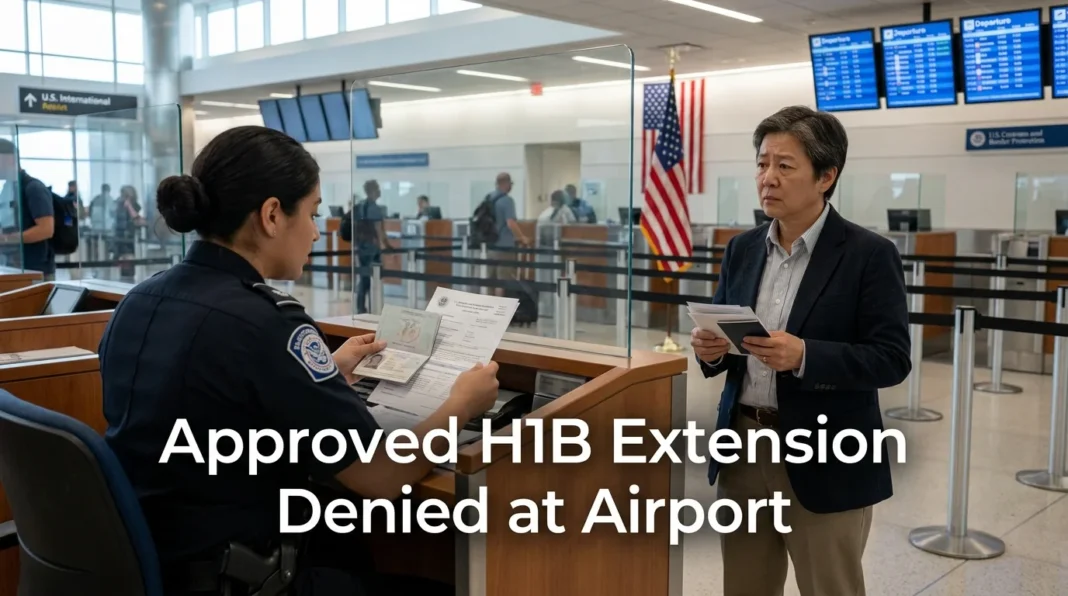

An approved H1B extension denied at airport situation can happen because USCIS approval does not guarantee admission to the United States. U.S. Customs and Border Protection makes a separate admissibility decision when you arrive. A valid visa and Form I-797 support your request for entry, but CBP can still refuse admission based on the facts presented at inspection.
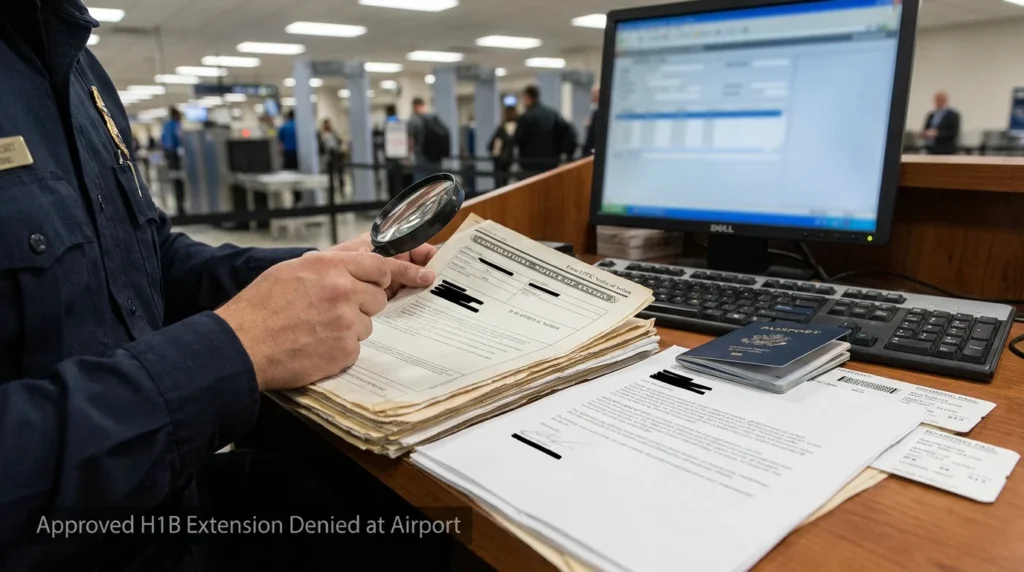
If you were refused entry, first determine exactly what CBP decided. A withdrawal of your application for admission, an expedited removal, a document problem, and a deferred inspection can have very different consequences. Get copies of any paperwork and speak with a qualified U.S. immigration attorney before making another travel attempt.
| Key issue | What it means |
|---|---|
| USCIS approval | Confirms approval of the employer’s H-1B petition or extension request |
| Visa stamp | Allows you to travel to a U.S. port of entry and request admission |
| CBP inspection | Determines whether you may enter the United States on that trip |
| Form I-94 | Records your admission classification and authorized period of stay after entry |
| Refused admission | Requires you to identify the legal or factual reason before trying to return |
| Record or I-94 error | May sometimes be reviewed through a CBP Deferred Inspection Site |
Direct answer: An approved H-1B petition does not give an automatic right to enter the United States. CBP officers inspect arriving travelers and decide admissibility at the port of entry. If admission is refused, obtain the CBP records, identify the stated reason, preserve your employment documents, and get case-specific legal advice before traveling again.
Approved H1B Extension Denied at Airport: Why CBP Can Still Refuse Admission
Three different government functions are involved in many H-1B travel cases. USCIS adjudicates the employer’s petition. The Department of State generally handles visa issuance abroad. CBP decides whether an arriving traveler may enter the United States.
The federal regulation governing H-class nonimmigrants specifically contemplates the presentation of Form I-797 when an H-class beneficiary returns to resume qualifying employment. That approval notice is important evidence, but CBP still conducts an admission inspection.
The Department of State also makes the distinction clear. A visa lets a foreign national travel to a port of entry and request permission to enter. It does not guarantee that CBP will admit the traveler.
A refusal can arise when the facts at the airport do not appear to match the approved petition. Problems may involve employment changes, conflicting answers, immigration history concerns, missing entry documents, or other possible grounds of inadmissibility.
For example, an officer may ask whether the H-1B job still exists and whether you are returning to work for the petitioning employer. A material change that was not reflected in the immigration filings may prompt closer review.
A documentation issue can also cause trouble. Carrying an approval notice alone does not replace other entry documents that may be required for your circumstances.
What Happens During CBP Inspection?
Every person seeking admission is subject to inspection. CBP says a noncitizen seeking lawful entry must establish admissibility to the officer’s satisfaction. Section 212 of the Immigration and Nationality Act, codified at 8 U.S.C. 1182, lists the specific grounds that can make an arriving traveler inadmissible.
An officer can refer you to secondary inspection when additional review is needed. Secondary inspection does not, by itself, mean that your H-1B petition has been revoked or that you will be refused entry.
The final result matters much more than the fact that secondary inspection occurred.
| Possible outcome | What happens | Why the distinction matters |
|---|---|---|
| Admission | CBP permits entry and creates an admission record | Check your I-94 after arrival |
| Deferred inspection | CBP requests additional documents or later review | You may need to report to a designated CBP office |
| Withdrawal of application | CBP permits withdrawal rather than completing admission | Future consequences depend on the facts and records |
| Finding of inadmissibility or removal | CBP formally refuses admission under immigration law | This can affect future travel, visas, and admission |
CBP states that withdrawal of an application for admission may be permitted in some situations at the officer’s discretion. A finding of inadmissibility can also affect later admission and may result in visa cancellation.
Deferred inspection is different. CBP uses Deferred Inspection Sites when an immediate immigration decision cannot be completed because additional information or documentation is needed. Those offices can also review certain errors made in arrival documents.
7 Steps to Take After an Airport Refusal
1. Identify exactly what CBP did
Do not rely only on the phrase “denied entry.” Review every document CBP gave you.
Find out whether the record describes a withdrawal of application for admission, an inadmissibility finding, expedited removal, document deficiency, or another result. The next legal step depends heavily on that distinction.
2. Keep copies of every document
Preserve your passport pages, boarding records, Form I-797, visa, CBP paperwork, employment letters, and relevant communications with your employer.
Write down what happened while the details remain fresh. Include the airport, date, questions asked, answers given, and documents reviewed.
3. Contact your employer and immigration counsel
Tell the sponsoring employer about the refusal promptly. The employer’s immigration counsel may need to compare the questioning at the airport with the approved petition.
LawBlink’s guide on how an immigration lawyer can help with a case explains why professional review can matter when visa records, filings, and immigration history need to be evaluated together.
4. Check whether the employment facts changed
Compare your current job against the approved filing. Review the employer, work location, position, duties, salary, and other material facts.
A traveler should not assume an older approval notice resolves a later change in employment circumstances. Your attorney can determine whether any new filing or other action is needed.
5. Fix an I-94 error if you were admitted
Sometimes the traveler is admitted, but the electronic I-94 contains the wrong classification or end date. That is different from being refused admission.
CBP says Deferred Inspection Sites can review certain errors made at the time of entry, including incorrect nonimmigrant classification or period of admission. Travelers can retrieve their electronic I-94 after arrival and check it for accuracy.
6. Consider DHS TRIP when the problem involves travel records
The Department of Homeland Security Traveler Redress Inquiry Program can accept inquiries from people who were denied entry or repeatedly sent to secondary screening.
DHS explains that TRIP coordinates with government agencies when relevant records may need review or correction. It does not guarantee a favorable immigration decision.
7. Resolve the problem before booking another entry attempt
A second trip does not erase the first inspection record. Reentry without addressing the original issue may result in another refusal or added complications.
Before traveling, have qualified counsel review the refusal documents, petition history, immigration record, and proposed entry documents. LawBlink also provides a broader overview of U.S. immigration law issues and its Law Hub legal resources for readers who want additional legal background.
Documents to Review Before Future H-1B Travel
No single travel packet guarantees admission. Your documents should match your current circumstances and the petition under which you seek entry.
Common records to review with counsel usually include the following.
- A valid passport
- A valid H-1B visa stamp when one is required
- The applicable Form I-797 approval notice
- Current evidence that the qualifying job remains available
A traveler with an earlier refusal on record usually needs a second set of papers as well.
- Recent employment records where appropriate
- Copies of relevant petition materials
- Any documents addressing the issue raised during the earlier inspection
- Prior CBP paperwork if you were refused entry
The governing H-class regulation states that the beneficiary should retain the I-797 approval notice and present it upon reentering the United States to resume the approved employment.
Your documents must also tell a consistent story. If the job, employer, worksite, or immigration history has changed, papering over the difference can create a larger problem.
Does an Airport Refusal Cancel the H-1B Approval?
Not automatically in every case.
A CBP decision about admission and a USCIS decision approving an employer’s petition are different actions. The exact effect of an airport incident depends on what CBP found and whether another agency later takes action concerning the petition or visa.
That is why the paperwork matters. Do not assume either that the H-1B approval remains fully usable or that it has automatically disappeared.
Have counsel review the agency records before deciding how to proceed.
What If CBP Admitted You but Gave the Wrong I-94 Date?
Check your electronic I-94 after each international entry.
The Department of State explains that the admission record determines the authorized period of stay for a particular entry. CBP also directs travelers with certain entry-created I-94 errors to a Deferred Inspection office.
If you notice a mismatch between your admission record and the expected H-1B period, address it promptly. Do not assume the system will correct itself.
The Next Step After an H-1B Airport Refusal
An approved H-1 B extension denied at the airport should be treated as a specific immigration problem, not a routine travel delay. Find out what CBP recorded, preserve the documents, compare your current employment with the approved petition, and correct any record errors through the proper channel.
Most importantly, do not make a second international travel decision based solely on USCIS’s approval of the extension. A U.S. immigration attorney can review the actual CBP outcome and advise you on the safest lawful path for your circumstances.
Frequently Asked Questions
DHS TRIP accepts redress inquiries from travelers who were denied entry or repeatedly referred for secondary inspection. Its role is record review and coordination, not to replace immigration court procedures or to guarantee admission.
Deferred Inspection Sites can review certain unresolved admission matters and errors in arrival documents. They are not a general appeal system for every refusal. Whether deferred inspection applies depends on what happened at the port of entry.
No. Secondary inspection is an additional review process. A traveler can still be admitted after secondary inspection.
It usually means USCIS approved the employer’s H-1B filing, but CBP did not admit the traveler during a later inspection. The exact consequences depend on the formal outcome recorded by CBP.
Yes. USCIS petition approval and CBP admission are separate decisions. CBP decides whether an arriving traveler is admissible each time that person seeks entry.
Can CBP deny entry even if my H-1B extension was approved?
Yes. USCIS petition approval and CBP admission are separate decisions. CBP decides whether an arriving traveler is admissible each time that person seeks entry.
What does an approved H1B extension denied at the airport mean?
It usually means USCIS approved the employer’s H-1B filing, but CBP did not admit the traveler during a later inspection. The exact consequences depend on the formal outcome recorded by CBP.
Is secondary inspection the same as being denied entry?
No. Secondary inspection is an additional review process. A traveler can still be admitted after secondary inspection.
Can a Deferred Inspection Site reverse an airport denial?
Deferred Inspection Sites can review certain unresolved admission matters and errors in arrival documents. They are not a general appeal system for every refusal. Whether deferred inspection applies depends on what happened at the port of entry.
Should I try entering through another U.S. airport?
Changing airports does not remove the earlier government record. Resolve the reason for the first refusal before attempting entry again.
Can DHS TRIP help after a CBP denial?
DHS TRIP accepts redress inquiries from travelers who were denied entry or repeatedly referred for secondary inspection. Its role is record review and coordination, notto replaceg immigration court procedures or to guarantee admission.