

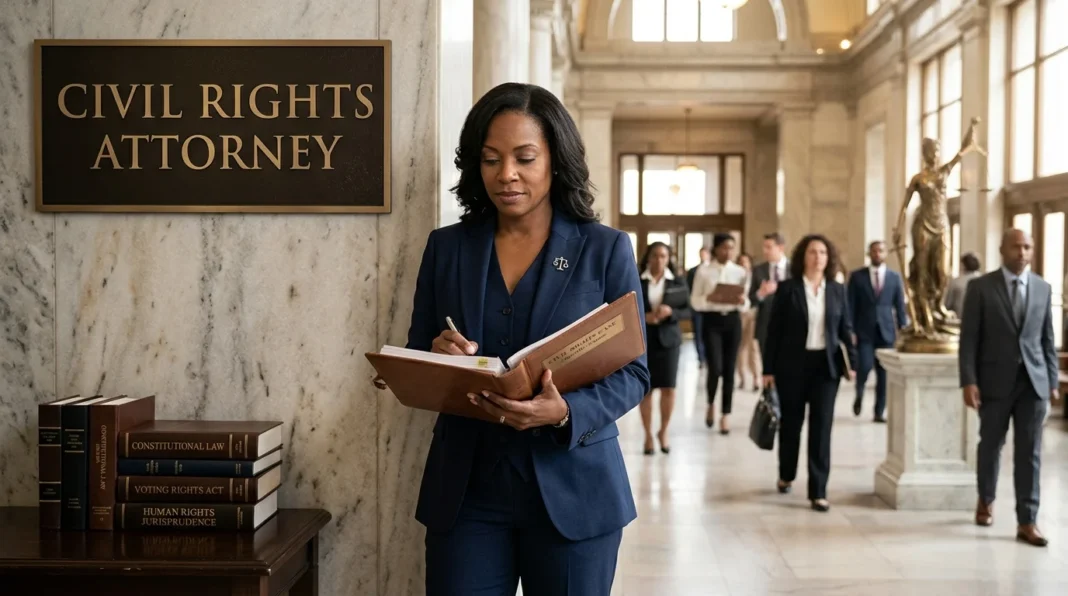

If you believe discrimination, police misconduct, retaliation, or another violation of protected rights has harmed you, a civil rights attorney can assess which laws apply and whether you have a viable claim. These cases often involve strict procedures and filing deadlines, so getting legal guidance early can protect options that may disappear with time.
Short answer: A rights lawyer investigates suspected constitutional or anti-discrimination violations, identifies the responsible parties, preserves evidence, handles agency filings when required, negotiates settlements, and may bring a lawsuit in state or federal court. The right lawyer should have experience with the specific type of violation you experienced.
| Situation | Possible legal route | What to preserve first |
|---|---|---|
| Police excessive force or unlawful arrest | Constitutional claim, often involving 42 U.S.C. § 1983 | Videos, photographs, medical records, names, badge numbers |
| Workplace discrimination | EEOC charge and possible later lawsuit | Emails, evaluations, messages, HR complaints |
| Disability discrimination | ADA or related federal/state protections | Accommodation requests, responses, policies, medical documentation |
| Racial discrimination | Federal or state anti-discrimination law | Written statements, comparative treatment, witness information |
| Retaliation after reporting misconduct | Employment, constitutional, or whistleblower protections | Original complaint, dates, later disciplinary actions |
Key Takeaways
- Different types of rights violations follow different legal procedures.
- Evidence can disappear quickly, especially videos, electronic messages, and witnesses’ memories.
- Employment claims may require an administrative filing before a lawsuit.
- Claims against state or local officials may involve 42 U.S.C. § 1983.
- Attorney fees may be hourly, contingency-based, pro bono, or affected by fee-shifting statutes.
- A lawyer who handles your exact type of claim is usually more useful than a general litigator.
What Does This Type of Lawyer Actually Do?
A rights lawyer starts by separating conduct that feels unfair from conduct that may violate a specific law. That distinction matters. Courts require a legal basis for a claim, not simply proof that someone acted badly.
For example, 42 U.S.C. § 1983 provides a route for claims against people acting under state or local government authority when they deprive someone of federally protected rights.
A lawyer may then:
- Review records and create a timeline.
- Identify the correct defendants and legal theories.
- Request government, employment, medical, or video records.
- Interview witnesses.
- Handle administrative complaints.
- Negotiate before or after a case is filed.
- Seek damages, court orders, or other available remedies.
LawBlink’s discussion of racial discrimination lawsuits shows how one area can involve employment, housing, education, public services, and law enforcement rather than a single type of dispute.
Cases a Rights Lawyer May Handle
The practice covers more than one statute or courtroom procedure. Attorneys often narrow their work to a few categories because each area has different rules. Common matters include police excessive-force claims, unlawful arrests, racial discrimination, workplace bias, disability discrimination, voting disputes, prisoner-rights cases, and First Amendment retaliation.
The U.S. Department of Justice accepts reports involving matters such as police misconduct, discrimination in education, voting access, disability issues, and treatment in custody.
Employment cases can overlap with other legal fields. LawBlink’s article on the Workday lawsuit and alleged AI hiring bias is one example. The dispute involves claims related to race, age, disability, and automated employment screening.
That overlap is one reason attorney specialization matters. Someone who regularly litigates excessive-force cases may have a different skill set from a lawyer who concentrates on workplace discrimination.
When Should You Call a Civil Rights Attorney?
Contacting counsel makes sense when the conduct caused a meaningful loss, involves a government actor, appears connected to a protected characteristic, or is followed by retaliation.
You should also consider legal help when:
- You were injured during an encounter with law enforcement.
- An employer took action against you after you reported discrimination.
- You were denied an accommodation because of a disability.
- An institution treated comparable people differently based on race, sex, religion, national origin, or another protected status.
- You received an agency notice, disciplinary letter, termination notice, or legal document.
- You are unsure which filing deadline applies.
Don’t assume that every claim gives you several years to decide. Some administrative deadlines are measured in months.
What Evidence Should You Save Before a Consultation?
Start with material that may be deleted, overwritten, lost, or forgotten. Save original emails, text messages, photographs, videos, letters, policies, disciplinary records, performance reviews, medical records, and complaint documents. Keep copies outside an employer-owned computer or account when you can do so lawfully.
Write a factual timeline while your memory is fresh. Include dates, locations, names, witnesses, and details about what happened before and after the event. Don’t edit original recordings or documents. A lawyer may want the complete file, including its metadata and surrounding context.
For employment-related matters involving leave or retaliation, LawBlink also covers how documentation and timing can affect a claim in its FMLA violation attorney guide.
Deadlines Can Change the Entire Case

Employment discrimination provides a clear example of why timing matters. The EEOC’s guidance on filing a charge of employment discrimination states that a charge generally must be filed within 180 calendar days. That period may extend to 300 days when a qualifying state or local agency enforces a law prohibiting the same type of discrimination. Federal employees and applicants generally follow a different process and usually must contact an EEO counselor within 45 days.
Those deadlines do not apply to every legal claim. Police-misconduct, housing, education, voting, and state-law cases can follow different limitation periods and notice rules.
That is why copying a deadline from another person’s case is risky. The correct deadline depends on the claim, defendant, jurisdiction, and events involved.
You may also report a possible violation directly to the Department of Justice. Its current online system accepts reports from the public, and providing contact information is optional.
An agency complaint and private legal representation are not the same thing. Filing with an agency does not automatically mean that the agency will become your personal lawyer.
How Do Lawyers Charge for These Cases?
There is no single national fee structure. Some attorneys take damages cases on a contingency basis. Others charge hourly rates, especially for advice, investigations, or matters in which money damages are not the main goal. Nonprofit groups and legal clinics may provide free representation in selected cases.
Federal law can also affect attorney fees. Under 42 U.S.C. § 1988, a court may award a reasonable attorney’s fee to a prevailing party in proceedings brought under several listed federal statutes, including § 1983.
Fee-shifting does not mean every client automatically pays nothing. Ask these questions before signing an agreement:
- Is the fee hourly or contingent?
- Who pays filing, deposition, expert, and record costs?
- Are case expenses deducted before or after a contingency percentage is calculated?
- What happens if the claim ends without a recovery?
- Does the lawyer expect to seek statutory fees from the defendant?
Get the answers in writing.
How to Choose the Right Lawyer
Start with subject-matter experience rather than advertising claims. Ask how often the lawyer handles cases like yours, whether those cases are filed in state or federal court, and who will perform the day-to-day work. For a government-misconduct claim, ask about the lawyer’s experience with constitutional litigation and § 1983.
For an employment case, ask how often the lawyer handles EEOC charges and retaliation claims. A lawyer familiar with the administrative stage may catch problems before litigation begins.
You can also review LawBlink’s Find a Lawyer resources while comparing legal help.
A useful consultation should include a realistic discussion of weaknesses. Be cautious when someone guarantees a particular settlement or verdict before reviewing the records.
Your Next Step
If you think a protected right was violated, create a timeline and preserve the original records first. Then look for a lawyer whose regular practice matches the type of problem you experienced.
Bring dates, documents, witness names, photographs, messages, agency correspondence, and a short explanation of the result you want. Early legal advice can help you separate a viable claim from a frustrating event that the law does not cover.
Frequently Asked Questions
There is no standard price. Lawyers may use contingency fees, hourly billing, pro bono representation, or another arrangement. Some federal claims may also permit a prevailing party to seek attorney fees under a fee-shifting statute. Ask about both attorney fees and case expenses before hiring anyone.
Yes. Government agencies accept certain complaints directly from individuals. The DOJ provides an online reporting process, while the EEOC accepts employment-discrimination charges.
Whether an agency complaint is enough depends on your situation. A private lawyer can advise you about additional claims and deadlines.
No. A legal claim normally requires conduct prohibited by a constitution, statute, regulation, or other enforceable rule.
The facts still matter. Unequal treatment may become legally significant when it involves a protected characteristic, retaliation, government action, or another recognized right.
Potential claims depend on who acted, what happened, and the legal basis for liability. Section 1983 is frequently used to seek redress for federal-rights violations committed under color of state law.
Claims involving a municipality can raise additional requirements, so misconduct by an individual officer does not automatically establish liability against an entire city or department.
Usually not. A lawyer can identify which records matter and may be able to preserve material you cannot obtain yourself.
Waiting can also create deadline problems. Bring what you have and explain what you believe exists elsewhere.