
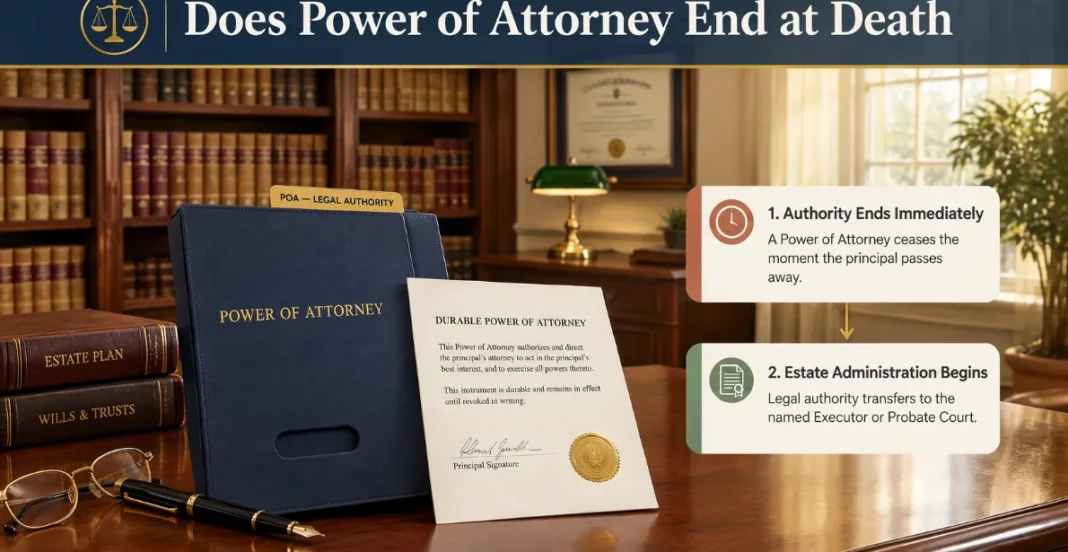

If you are asking does power of attorney end at death, the general U.S. answer is yes. The agent’s authority normally stops when the principal dies. A durable document can survive incapacity, but it does not normally survive death.
After death, someone else must have legal authority to manage the deceased person’s affairs. That person may be an executor, court-appointed administrator, or trustee, depending on the asset. State law and the estate plan determine who can act next.
Key Information at a Glance
| Question | General U.S. Rule |
|---|---|
| Does a POA continue after the principal dies? | No, the authority generally terminates at death |
| Does a durable POA survive death? | No, durability concerns incapacity, not death |
| Who handles estate assets afterward? | Usually an executor or court-appointed administrator |
| What about trust property? | A successor trustee may control assets already held in the trust |
| Can a former agent use the document to sell property? | Generally no after learning of the principal’s death |
| Do state laws differ? | Yes, especially regarding notice and good-faith actions |
| Is a will the same as a POA? | No, they operate at different stages |
Direct answer: A power of attorney generally ends when the principal dies in the United States. A durable POA may continue during incapacity, but death ends the agent’s authority. Afterward, authority usually shifts to an executor, administrator, or trustee with legal control over the relevant property.
Key Takeaways
- An agent usually cannot keep signing checks or transferring property after the principal dies.
- “Durable” means the document can remain effective during incapacity.
- The executor named in a will does not automatically gain authority before the required legal process.
- An administrator may be appointed when no valid executor can serve.
- A trustee may control property already owned by a trust.
- Some states protect good-faith actions taken before an agent learns about the death.
- State-specific legal advice can matter when transactions were already underway.
Why a Power of Attorney Stops When the Principal Dies

A POA creates an agency relationship between a principal and an agent. The agent receives authority to act for the living principal within stated limits. Once the principal dies, that agency generally has no living principal behind it.
Does Power of Attorney End at Death? Section 110 of the Uniform Power of Attorney Act lists the principal’s death as a terminating event. Several states use the same rule in their own statutes. For example, Washington law expressly provides that the document terminates when the principal dies.
The same approach appears in the North Carolina Uniform Power of Attorney Act. This makes death different from incapacity. Incapacity may leave a durable document effective, while death normally ends the agency itself.
Does Power of Attorney End at Death Even If It Is Durable?
Yes, a durable POA normally ends when the principal dies. The word “durable” often causes confusion because it sounds permanent. Legally, durability generally means the authority survives the principal’s incapacity.
Cornell Law School’s Legal Information Institute states that a durable power of attorney typically remains in effect until the principal’s death or until the document is revoked. It does not give an agent permanent authority over the estate. The former agent therefore needs a different legal basis to act afterward.
This distinction matters when families have relied on the same agent for years. Someone may have paid bills and managed investments during the principal’s illness. Those responsibilities do not automatically continue after death.
Who Has Authority After Death?
The answer depends on the deceased person’s estate plan and state probate law. A person named as executor in a will commonly becomes responsible for estate administration. The executor may still need court appointment before exercising formal powers.
When there is no will, a probate court can appoint an administrator or similar personal representative. That person handles estate property under applicable state law. LawBlink’s guide to who does what in estate planning explains the different functions of executors and administrators.
Trust assets can follow another path. Property already titled in a trust may be managed by a successor trustee after death. That authority comes from the trust instrument and trust law, not from the expired POA.
What Should a Former Agent Do After the Principal Dies?
A former agent should stop using the document after learning of the principal’s death. Banks, investment firms, and other institutions should be told about the death promptly. They commonly request a certified death certificate before changing their records.
The former agent should also preserve financial records created while serving. Account statements, receipts, tax records, and transaction histories may help the estate representative. Keeping clear records can also answer later questions about actions taken before death.
The next step is usually to identify the person with post-death authority. That may involve locating the will, identifying a trustee, or starting probate. Families facing disputes can review LawBlink’s guide to probate litigation for an overview of contested estate proceedings.
Can an Agent Finish a Transaction Started Before Death?
Death generally ends future authority, even when a transaction was already being discussed. A former agent should not assume an unsigned sale or transfer can be completed. The estate representative may need to finish, approve, or restart the transaction.
There is an important state-law qualification involving knowledge of termination. Some statutes protect an agent who acts in good faith without actual knowledge that authority ended. The Uniform Power of Attorney Act includes such a provision, and several adopting states follow similar language.
Pennsylvania provides a clear example of this issue. Its statute can protect good-faith actions by an agent without actual knowledge of the principal’s death. That protection is not permission to keep acting after the agent learns of the death.
Can a Former Agent Access the Deceased Person’s Bank Account?
A former agent generally should not use POA authority after learning that the principal died. Banks may freeze or restrict accounts after receiving notice of death. Access then depends on account ownership, beneficiary designations, and estate authority.
Joint accounts and payable-on-death accounts may have different rules. Assets owned by a trust can also follow trust terms rather than probate procedures. Those differences concern ownership and beneficiary rights, not continued POA authority.
Using an expired document can create disputes with beneficiaries or financial institutions. Questions may become more serious when money was transferred after death. LawBlink’s article on who can override a power of attorney provides additional context about termination and challenges.
Power of Attorney vs. Executor: What Changes at Death?
An agent and an executor perform different legal roles. An agent acts for a living principal under delegated authority. An executor manages a deceased person’s estate under a will and applicable probate law.
Being named in both documents does not merge those jobs. A person might serve as agent during life and later serve as executor. The legal authority for the second role comes from the will and probate process.
That distinction can affect banks, real estate closings, and contracts. Institutions may require letters testamentary or similar court documents from an executor. Showing the old POA may no longer establish authority.
What If There Is No Will?
Dying without a will is called dying intestate. State intestacy laws determine who inherits assets subject to probate. A court usually appoints an administrator or personal representative to manage the estate.
The former agent does not automatically become that administrator. Family relationship or prior financial involvement may also be insufficient by itself. The probate court applies state rules when deciding who can serve.
Smaller estates sometimes qualify for simplified procedures. Requirements and dollar limits differ widely among states. A local probate lawyer can explain which process applies to a specific estate.
Other Ways a POA Can End Before Death
Death is not the only event that can terminate delegated authority. A competent principal can generally revoke the document. A limited document can also expire after its stated purpose is completed.
A non-durable document may end when the principal becomes incapacitated. An agent can also resign, die, or become unable to serve. A successor agent may take over when the document and state law permit it.
Divorce can affect an appointment when the spouse is the named agent. The precise effect depends on state law and the document’s terms. Courts may also intervene when abuse, fraud, or misuse is alleged.
When Legal Help May Be Useful
Professional advice can help when the former agent made transactions near the date of death. It can also help when heirs disagree about control of property. State-specific rules become especially important when real estate or business interests are involved.
A probate attorney can review the will, account ownership, and existing estate documents. The lawyer can also determine whether a court appointment is needed. LawBlink’s overview of a death attorney’s role explains several legal tasks that can arise after a death.
Seek advice promptly when a bank rejects documents or a property transfer is pending. The same applies when someone continues using delegated authority after learning of the death. Early legal review can prevent unauthorized transactions and added estate disputes.
The Bottom Line
A POA is designed to let another person act for someone who is still alive. Death normally ends that authority and begins a different legal process. Executors, administrators, and trustees then act under separate sources of authority.
If a loved one has died, avoid continuing transactions based only on the old document. Identify the estate representative and notify institutions that relied on the agency. State-specific advice is sensible when property transfers, disputed transactions, or probate questions remain unresolved.
Frequently Asked Questions
Does power of attorney end at death immediately?
Yes, the question of whether a power of attorney ends at death is generally answered by the same rule across U.S. jurisdictions. The principal’s death normally terminates the authority granted to the agent. State statutes may still protect certain good-faith actions taken without knowledge of the death.
Can a durable POA be used after someone dies?
Generally, no. Durability allows the authority to continue when the principal becomes incapacitated while alive. It does not normally extend an agent’s authority beyond the principal’s death.
Can the former agent pay funeral expenses?
The former agent cannot rely on expired POA authority simply because an expense is necessary. An authorized estate representative may pay valid estate expenses under state law. Other lawful payment arrangements may also exist outside the former agency.
Does an executor have authority immediately when someone dies?
Not always. Being named in a will identifies the proposed executor, but state procedure may require formal appointment. Banks and other institutions often ask for court-issued proof of authority.
What happens if someone uses a POA after death?
The consequences depend on state law, the person’s knowledge, and the transaction. An unauthorized act may be challenged or refused by an institution. Intentional misuse can also expose the actor to financial or legal claims.
Does a POA override a will?
No, the documents usually operate at different times and serve different purposes. A POA governs delegated authority during the principal’s lifetime. A will directs probate estate administration after death.