



An online divorce form can help you prepare court paperwork without starting from scratch. Yet the correct documents depend on your state, county, children, property, and whether your spouse agrees. No single federal form works for every divorce in the United States.
Direct answer: U.S. divorce forms are usually state-specific court documents. Start with your state judiciary or local court website, then choose the packet that matches your circumstances. You may complete many forms electronically, but online preparation does not mean a judge grants the divorce online.
Online Divorce Forms at a Glance
| Question | General U.S. answer |
|---|---|
| Is there one national divorce form? | No. State law mainly controls the divorce process. |
| Where should you find forms? | Start with your state court or local court website. |
| Can forms be completed online? | Many states offer fillable forms or guided online interviews. |
| Can you file electronically? | Some courts permit or require electronic filing. |
| Are court forms free? | Official forms are often free, but filing fees usually apply. |
| Is online divorce best for contested cases? | Usually not. Disputes may require legal advice or court hearings. |
| Who grants the divorce? | A court and judge finalize the divorce, not an online form provider. |
Key Takeaways
- Divorce paperwork varies by state and sometimes by county.
- Official court websites should be your first source for current forms.
- Uncontested cases are usually easier to handle through self-help tools.
- Children, property, support, and disagreements can require extra documents.
- Court filing fees remain separate from private document-preparation charges.
- Electronic form preparation and electronic filing are not the same thing.
- A lawyer may be appropriate when important rights or disputed issues are involved.
Why Divorce Forms Differ Across the United States
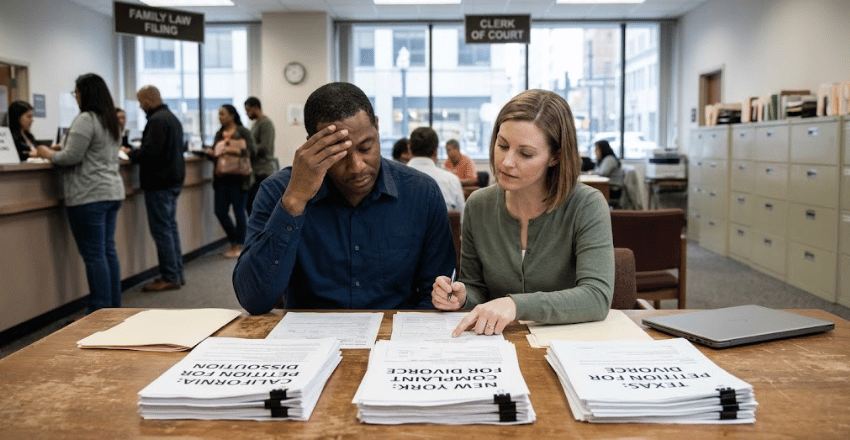
Family law is primarily governed by individual states. Each state establishes its own filing requirements, terminology, residency rules, and court procedures. Local courts can also impose additional administrative requirements.
Even the name of the opening document can vary. One jurisdiction may use a petition for dissolution, while another uses a complaint for divorce. Required financial, parenting, service, and judgment documents can also differ.
Official court resources clearly show these differences. Minnesota separates forms based on agreement status and whether children are involved. Illinois also publishes different approved forms for cases involving children and other family-law issues.
That variation makes location your first important question. A form prepared for another state may not satisfy your court’s rules. Always confirm the jurisdiction before entering personal or financial information.
How to Use an Online Divorce Form Correctly
1. Confirm where you are eligible to file
Start by identifying the state where the case should be filed. States set residency rules that determine whether their courts can hear your divorce. County-level venue rules may determine the specific courthouse.
Do not assume you should file where you married. Your present residence often matters more than the wedding location. Check the current instructions published by your state’s judiciary.
2. Decide whether the divorce is contested
An uncontested divorce generally means the spouses have resolved the important issues. Those issues can include property, debts, support, custody, and parenting arrangements. Court definitions and procedures still vary by state.
Online self-help systems often work best for straightforward uncontested cases. New York, for example, publishes a detailed uncontested-divorce packet and a DIY program for qualifying cases. Its courts caution that contested issues can make those materials unsuitable.
A spouse’s lack of cooperation does not always prevent a case from moving forward. Procedures for default, service, and absent spouses vary significantly. LawBlink’s discussion of filing without a cooperating spouse in New Jersey explains one state-specific example.
3. Use the court’s official forms when possible
Search your state judiciary’s website for divorce, dissolution, family law, or self-help forms. Then verify that the packet fits your family and financial circumstances. Check the revision date when the court provides one.
Several states now provide guided online tools. Oregon offers free Guide & File interviews for divorce and other family matters. Minnesota also provides an online interview that creates forms based on a user’s answers.
Official tools have an important advantage. They come directly from the court system that accepts the paperwork. That reduces the risk of relying on an outdated generic template.
4. Gather the information before completing anything
Preparing your records first can reduce errors and repeated work. Court forms often request detailed personal, financial, and family information. The exact list depends on the case.
You may need several items. Examples follow.
- Full legal names and contact information.
- Marriage date and location.
- Separation information.
- Addresses and residency details.
- Information about minor children.
- Income and employment information.
- Assets, debts, and real estate details.
- Existing support or custody orders.
- Proposed property or parenting agreements.
Financial information deserves special attention. Incorrect numbers can affect support, property issues, or required disclosures. Review all entries before signing anything.
5. Check signatures, notarization, and service rules
Completing the paperwork does not finish the filing process. Some documents may require signatures, sworn statements, notarization, or supporting exhibits. Rules differ across courts.
You may also need to formally notify your spouse. Courts generally have specific service procedures and proof requirements. Never assume emailing or handing over documents satisfies those rules.
Service can become especially complicated when a spouse cannot be located. Courts may offer alternative procedures under defined circumstances. Consider legal advice when service problems could affect the validity of your case.
6. File with the correct court
After reviewing the documents, follow your court’s filing instructions. Some jurisdictions accept paper filings, while others support electronic submission. Certain courts may require electronic filing for self-represented litigants.
Iowa, for example, provides free divorce forms through its judiciary. Its court guidance says electronic filing is generally required unless permission for paper filing is granted.
Keep copies of everything you submit. Save filing confirmations, case numbers, payment records, and clerk notices. Organized records make later stages easier to manage.
7. Follow every deadline until judgment
Filing starts the court process, not the end. Your case may involve response periods, financial disclosures, waiting periods, hearings, settlement documents, or final judgment paperwork. Requirements depend on state law.
Temporary issues can also arise before a divorce becomes final. Courts may address support, custody, housing, or expenses while the case remains pending. LawBlink’s explanation of pendente lite orders shows how temporary family-court relief can operate before final judgment.
Read every notice from the court promptly. Missing a deadline can delay the case or create procedural problems. Contact the clerk for procedural information or a lawyer for legal advice.
What You’ll Need Before You Start
Set aside enough time to read the instructions before filling out your paperwork. Fast completion is less important than submitting accurate documents. A rejected filing can cost more time than careful preparation.
Gather your identification, marriage information, financial records, and children’s information. Also collect existing court orders and any written agreement with your spouse. Keep digital copies in a secure location.
Parents should pay special attention to custody and parenting documentation. LawBlink’s family court custody preparation guide explains useful records and preparation practices.
Free Court Forms vs. Paid Online Divorce Services
Official court forms are often available without a document-preparation charge. You may still owe filing, service, copying, or other court-related costs. Fee-waiver procedures may exist for qualifying filers.
Private online services can offer guided questionnaires and prepared documents. Their fees generally pay for convenience or document preparation rather than the divorce judgment itself. A judge still controls whether the marriage is legally dissolved.
Before paying a company, check what the price includes. Ask whether filing, service, revisions, or court fees cost extra. You should also confirm that the service supports your exact jurisdiction.
How Much Does Filing for Divorce Cost?
No single U.S. filing fee exists. Costs vary by state and sometimes by county. Additional expenses may include service, certified copies, mediation, or professional assistance.
New York provides a useful example of state variation. The New York State court system currently lists at least $335 in filing fees for an uncontested divorce, excluding other potential expenses. That amount should not be treated as a national estimate.
Some courts provide fee-waiver applications for people who cannot afford required charges. Eligibility rules differ. Check your court’s current instructions before assuming a waiver applies.
How Long Does an Online Divorce Take?
Online document preparation may be quick, but the legal process often takes longer. State waiting periods, service requirements, court workload, and unresolved issues can affect timing. The complexity of your finances or parenting arrangements can matter too.
An uncontested case may move more efficiently than a disputed case. Still, completing documents online does not bypass required court procedures. Your court’s current timetable provides the best guidance.
Avoid companies promising a guaranteed final date unless local law supports that claim. No document provider controls a judge’s calendar. Court approval remains necessary.
When You Should Consider Speaking With a Lawyer
Self-help forms can work well for straightforward cases. They become less suitable when important rights or disputed facts are involved. A short legal consultation can sometimes prevent expensive mistakes.
Consider professional advice in several situations. Examples follow.
- Significant or disputed property.
- A business or complex investments.
- Retirement accounts or pensions.
- Disputed child custody.
- Domestic violence or safety concerns.
- Hidden assets or financial misconduct.
- International property or children.
- Uncertain jurisdiction or residency.
- Problems locating or serving your spouse.
- Disagreement about support or major debts.
Temporary court orders may also affect finances or parenting before trial. These orders can carry immediate legal consequences. Review LawBlink’s broader guidance on what to do if your spouse refuses to sign for related explanations and resources.
Common Mistakes to Avoid
Using the wrong state’s packet is one of the easiest mistakes to prevent. Another common problem is selecting forms that do not match whether children or disputed issues exist. Always read the eligibility instructions first.
Incomplete financial information can also cause problems. Missing signatures, service errors, and outdated forms may lead to rejection or delay. Review the entire packet before submission.
Do not confuse document preparation with legal advice. A form can record your choices, but it cannot tell you whether those choices protect your interests. That distinction matters when property, support, or children are involved.
Frequently Asked Questions
Can I use one online divorce form in every U.S. state?
No. Each state has its own divorce laws, forms, and filing procedures. Some counties also impose local requirements.
Start with your state judiciary or court self-help website. Confirm that the documents match your circumstances before completing them. Do not rely on a generic national template without checking local requirements.
Are online divorce papers legally valid?
Proper court forms can be valid whether you complete them electronically or by hand. The documents must still meet your jurisdiction’s requirements. They also must be filed and processed correctly.
A website cannot grant a divorce. The court must accept the case and enter the required judgment. Follow your jurisdiction’s official instructions.
Can I file without a lawyer?
Many courts permit people to represent themselves. They often provide self-help forms and procedural instructions. Court staff usually cannot provide individualized legal advice.
Self-representation may be less suitable for complex or contested cases. Important property, custody, or support rights can be difficult to evaluate. A lawyer can explain how local law applies to your circumstances.
Can I file online if my spouse disagrees?
Electronic filing and an uncontested divorce are different concepts. A court may allow electronic submission even when spouses disagree. The disagreement can still create additional legal procedures.
Contested cases may involve answers, motions, hearings, discovery, or trial. The required documents will differ from a simple uncontested packet. Review your court’s contested-divorce instructions.
Are divorce forms free?
Many state courts provide official forms at no charge. Filing those documents usually involves court fees unless a waiver applies. Other expenses can arise during the case.
Private preparation services may charge separate fees. Those charges are separate from court filing costs. Review both before deciding how to proceed.
Your Next Step
Start with your state’s official judiciary website and identify the correct divorce packet. Read the eligibility and filing instructions before entering information. Then confirm any county-specific requirements with the court handling your case.
Use LawBlink’s family-law resources to understand related issues before making important decisions. If property, custody, support, safety, or jurisdiction is uncertain, consider speaking with a licensed attorney. Good paperwork begins with choosing the correct legal process.