

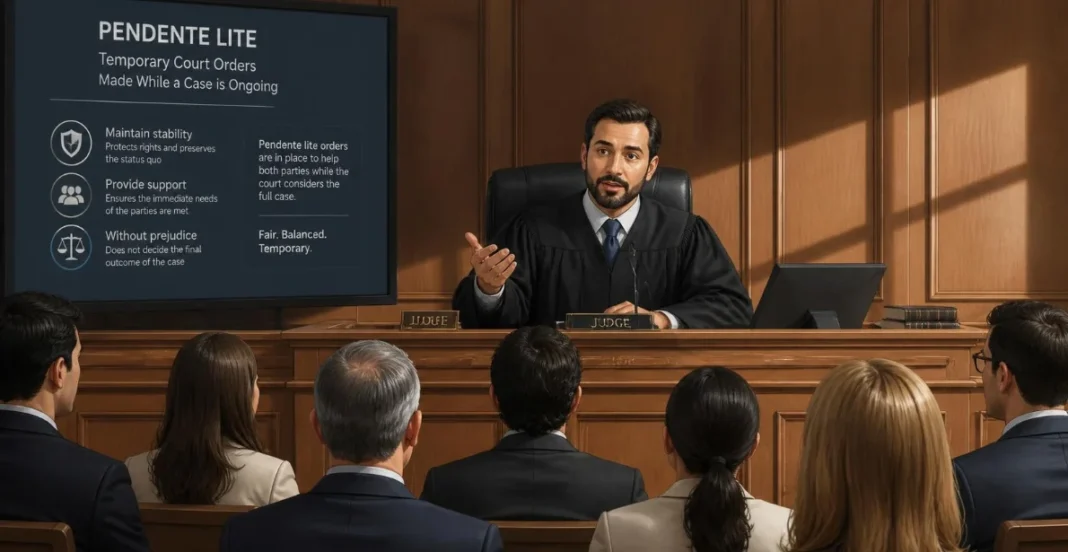

Pendente lite means “while litigation is pending.” In U.S. law, it usually describes temporary court relief before a case ends. These orders can address immediate problems while the parties wait for a final decision.
The term appears most often in divorce and family-law cases. A judge may temporarily address custody, support, housing, bills, or property use. The exact procedure and available relief depend on state law.
Direct answer: Pendente lite is a Latin legal phrase meaning “while the lawsuit is pending.” It usually describes temporary court orders effective during an active case. Those orders can manage support, custody, property, expenses, or other immediate needs until a final judgment replaces them.
Pendente Lite at a Glance
| Question | Short answer |
|---|---|
| What does it mean? | “While the lawsuit is pending” |
| Is the order temporary? | Yes, it generally operates during pending litigation |
| Where is it common? | Divorce, custody, support, and other civil proceedings |
| What can an order cover? | Support, custody, property use, bills, fees, and related temporary issues |
| Does it decide the final case? | No, temporary relief does not automatically determine the final judgment |
| Do rules differ by state? | Yes, terminology, procedure, standards, and available relief can differ |
Key Takeaways
- The phrase describes relief or arrangements operating while litigation remains unresolved.
- Family courts often use temporary orders to manage immediate financial and parenting needs.
- A temporary ruling remains legally significant even though it is not the final judgment.
- State laws determine how temporary relief is requested, evaluated, modified, and enforced.
- Anyone facing a temporary-order hearing should check the rules in their own jurisdiction.
What Does Pendente Lite Mean in U.S. Law?

The phrase comes from Latin and refers to something occurring during pending litigation. Legal dictionaries commonly translate it as “during the suit” or “while litigation continues.” Courts use the phrase when an issue needs temporary treatment before final resolution.
The Pendente Lite concept matters because lawsuits can take months or longer to resolve. Families still need workable arrangements during that period. Temporary relief helps address those practical needs without waiting for the final hearing.
Maryland courts describe the term as temporary arrangements involving custody, support, visitation, alimony, and family property. Those arrangements last until a final hearing or trial. This illustrates how broad temporary family-law relief can be.
What Can a Temporary Order Cover?
The available issues depend on the case and state law. Family courts frequently address problems that cannot reasonably wait for trial. The goal is usually short-term stability while litigation continues.
Common subjects can include the following.
- Temporary child custody
- Parenting time or visitation
- Child support
- Temporary spousal support
- Use of the family home
- Payment of household expenses
- Health insurance coverage
- Responsibility for certain debts
- Restrictions involving property
- Attorney fees or litigation expenses
For example, Pennsylvania law expressly recognizes alimony during pending divorce proceedings. Its statute can also permit reasonable counsel fees, expenses, and continued health coverage. That example should not be treated as a nationwide formula.
Parents facing temporary custody questions may also benefit from LawBlink’s family court custody preparation guide. It covers documentation, legal standards, and responsible conduct before court. Those preparation habits can matter whenever parenting arrangements are disputed.
How Does a Pendente Lite Order Work?
A party generally asks the court for temporary relief after litigation begins. The other party usually receives notice and an opportunity to respond. Exact filing requirements and hearing procedures depend on the jurisdiction.
A judge may review financial records, parenting circumstances, sworn statements, or other relevant evidence. The required showing changes with the relief requested. State statutes and local court rules determine the governing standard.
Once entered, the temporary order is binding while it remains effective. Calling an order temporary does not make compliance optional. A party should follow the order unless the court modifies, stays, or replaces it.
Temporary financial issues often overlap with child-support questions. LawBlink’s overview of child support laws discusses calculations, enforcement, modifications, and state variation. Readers should still verify current rules through their state court or attorney.
Is a Temporary Order the Same as a Final Judgment?
No. A temporary order handles issues while the underlying case remains unresolved. The final judgment decides matters under the standards governing final relief.
That difference can be important in a divorce. A temporary support arrangement may respond to immediate financial needs. Final alimony can involve different statutory factors and a broader evidentiary record.
Pennsylvania law illustrates the distinction clearly. It separately defines temporary support during a divorce proceeding and alimony following a divorce decree. Other states use different terminology and rules.
A temporary ruling can still affect daily life for months. Parties often build routines around parenting schedules, support payments, and household expenses. That practical effect makes careful preparation important.
Pendente Lite vs. Related Legal Terms
Several legal terms sound similar but describe different concepts. Confusing them can lead readers toward the wrong rule or procedure. The differences are easier to see side by side.
| Term | Meaning | Key distinction |
|---|---|---|
| Temporary order | Short-term court ruling | Broad term covering many interim rulings |
| Interim order | Order operating before final resolution | Often used similarly to temporary order |
| Final judgment | Court’s final resolution | Usually replaces temporary arrangements |
| Ex parte order | Order potentially entered without the other side initially present | Often tied to special or emergency procedures |
| Lis pendens | Notice concerning litigation affecting real property | A property notice, not temporary support or custody relief |
A lis pendens deserves special attention because its wording sounds related. It generally concerns notice that litigation may affect real-property interests. It should not be treated as another name for temporary family-law support.
How Long Does Temporary Relief Last?
There is no single nationwide duration. Temporary relief commonly continues until another order changes it or final judgment resolves the issue. The governing order and state procedure control the actual end date.
A case can also change before trial. Settlement, changed circumstances, or another court ruling may alter the temporary arrangement. Parties should read the specific order rather than assume an automatic expiration date.
Lengthy litigation can make temporary arrangements especially significant. A short-term order may govern family finances or parenting for a substantial period. That is one reason parties often seek legal advice early.
LawBlink’s article on why you need an attorney when getting divorced explains several issues counsel can help address. These include paperwork, support, custody, and negotiation.
Can a Temporary Order Be Changed?
Courts can sometimes modify temporary orders before the case ends. The available procedure depends on the jurisdiction and the type of order. A party may need to show changed facts or another legally sufficient reason.
Examples can include changed income, altered parenting circumstances, or new information affecting an existing arrangement. A disagreement alone may not justify modification. Local rules determine what evidence and filings are necessary.
Parties should avoid changing court-ordered terms privately without understanding the legal consequences. An informal agreement may not modify the signed order. A lawyer can explain the safest procedure under applicable state law.
What Happens if Someone Ignores the Order?
A temporary court order carries legal authority while it is in force. Violating it can lead to enforcement proceedings and other consequences permitted by state law. The available remedies depend on the order and jurisdiction.
Pennsylvania, for example, provides statutory enforcement mechanisms for certain support arrearages. Those mechanisms can include judgments and wage-related remedies. Other states may use different enforcement procedures.
People dealing with family litigation can explore LawBlink’s broader family law resources for related reading. State-specific advice should still come from qualified local counsel.
Practical Example
Imagine spouses file for divorce while sharing two children and a mortgage. The final divorce may require months of negotiation and discovery. Immediate questions still exist about parenting, bills, and financial support.
One spouse asks the court for temporary parenting time and support. The judge reviews the request and enters interim terms. Those terms govern the family until another order or final judgment replaces them.
The example shows why temporary relief exists. Courts can create workable rules without deciding every final issue immediately. The final case still proceeds through its normal process.
How to Prepare for a Temporary-Order Hearing
Preparation should focus on the specific relief being requested. Organized evidence usually makes facts easier for a court and attorney to evaluate. Avoid relying on assumptions about what a judge already knows.
Useful preparation may include the following.
- Reviewing the motion and requested relief
- Gathering recent income and expense records
- Organizing relevant parenting records
- Identifying current household obligations
- Following existing court orders carefully
- Keeping communications factual and respectful
- Reviewing local court instructions
- Discussing state-specific requirements with counsel
Do not assume another state’s procedure applies to your case. Family law remains heavily state-specific in the United States. Court forms, deadlines, evidentiary requirements, and available relief can differ substantially.
What to Do Next
Temporary orders can control important parts of your life before a case reaches trial. They can affect children, housing, expenses, and financial support. Treat any request or signed order with appropriate care.
Start by reading every court document and identifying applicable deadlines. Gather records connected to the relief being requested. Then check your state’s rules or speak with a licensed attorney in your jurisdiction.
This article provides general U.S. legal information rather than legal advice. Laws and court procedures differ by state and can change. An attorney can apply current local law to your particular facts.
Frequently Asked Questions
What does pendente lite mean in divorce?
It describes temporary relief during a pending divorce case. Courts may use such orders for support, custody, property use, or expenses. The available relief depends on the state and case.
Is a temporary order legally binding?
Yes, a court order generally remains binding while it is effective. Its temporary nature does not make it optional. Parties should follow it unless a court changes or replaces it.
Does temporary custody become permanent automatically?
No, temporary custody does not automatically become a final custody judgment. Final decisions follow the governing state standards and available evidence. Still, temporary arrangements can strongly affect a family’s daily routine.
Is temporary spousal support available in every state?
States handle temporary spousal support under their own statutes and procedures. Some jurisdictions use the Latin phrase, while others use terms like temporary support. Eligibility and calculations can therefore vary.
Can temporary relief include attorney fees?
Some jurisdictions permit temporary attorney fees or litigation expenses in appropriate cases. Pennsylvania expressly provides an example within its domestic-relations statute. You should check the law governing your own case.
Is pendente lite the same as lis pendens?
No. The first term generally concerns matters operating while litigation is pending. Lis pendens usually refers to notice concerning litigation affecting real property.