

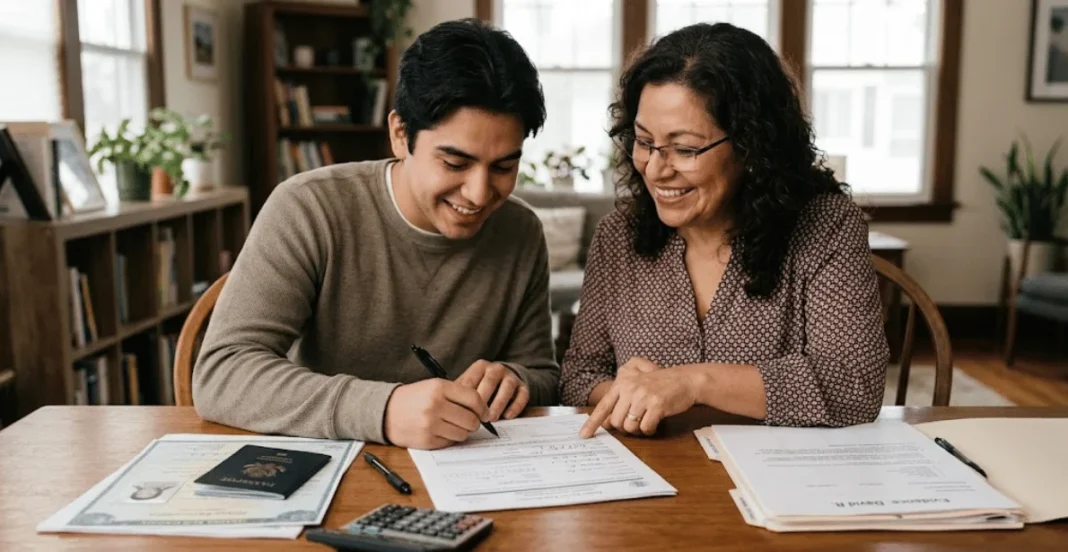

The Form I-130 Petition for Alien Relative is the starting point for many family-based U.S. immigration cases. A U.S. citizen or lawful permanent resident files the petition with U.S. Citizenship and Immigration Services to establish a qualifying family relationship. Approval is important, but it does not by itself give the beneficiary a green card, immigration status, or permission to work in the United States.
Form I-130 is the family petition U.S. citizens and lawful permanent residents use to prove a qualifying relationship for immigration. Filing it starts the family-based green card process but does not itself grant status. Petitioners must use the correct form edition, pay the correct fee, and submit sufficient evidence of the relationship.
| Key I-130 fact | Current information (USCIS, as of September 2026) |
|---|---|
| Government agency | U.S. Citizenship and Immigration Services |
| Current instruction edition | 04/01/24 |
| Online filing fee | $625 |
| Paper filing fee | $675 |
| Spouse petition | Form I-130A is also required |
| Main purpose | Establish a qualifying family relationship |
| Filing methods | Online or by mail |
| After approval | Adjustment of status or consular processing may follow |
| Immediate-relative FY2026 median | 12.9 months through May 31, 2026 |
As of September 2026, USCIS’s fee schedule lists a $625 fee for online filing and $675 for paper filing. The agency can update forms, fees, and filing procedures, so petitioners should verify the USCIS form and fee pages immediately before submitting a case. USCIS also warns that a filing with the wrong required fee can be rejected rather than accepted for processing.
Key Takeaways
- U.S. citizens can petition for a broader range of relatives than lawful permanent residents.
- A separate petition is generally required for each eligible relative.
- Spousal cases require Form I-130A in addition to the family petition.
- Evidence must prove both the petitioner’s qualifying status and the claimed family relationship.
- An approved petition does not automatically produce a green card.
- Family-preference beneficiaries can face an additional wait for an immigrant visa number.
- Petitioners should distinguish carefully between adjustment of status and consular processing.
What Is Form I-130 and What Does It Do?
The petition asks USCIS to recognize that a qualifying relationship exists between the petitioner and the foreign-national beneficiary. USCIS uses that relationship to determine whether the beneficiary falls into an immediate-relative or family-preference immigration category. The petition therefore creates the foundation for a later permanent-residence application rather than granting permanent residence on its own.
That distinction matters because the next stage depends on the beneficiary’s category and circumstances. A person eligible to adjust status in the United States may eventually file Form I-485, while someone processing abroad generally continues through the Department of State and the National Visa Center. LawBlink’s marriage-based green card overview provides additional context for couples dealing specifically with a spousal case.
Who Can File for a Family Member?

A U.S. citizen can generally petition for a spouse, children, adult sons or daughters, siblings, and parents. A citizen must be at least 21 years old to petition for a parent or sibling, and relationship-specific rules can affect eligibility in adoption and stepfamily cases. USCIS generally requires a separate petition for each eligible relative unless derivative-beneficiary rules apply to a particular family-preference category.
Lawful permanent residents have narrower options. They may petition for a spouse, an unmarried child under age 21, or an unmarried son or daughter age 21 or older, but they cannot use this petition for parents, siblings, or married children. If an unmarried son or daughter of a permanent resident marries before immigrating or adjusting status, USCIS instructions state that it may deny the petition or automatically revoke it because there is no corresponding category for married children of permanent residents.
| Petitioner | Relatives commonly eligible |
|---|---|
| U.S. citizen | Spouse, children, adult sons or daughters, parents, siblings |
| Lawful permanent resident | Spouse and unmarried sons or daughters |
| U.S. citizen petitioning for parent | Petitioner must be at least 21 |
| U.S. citizen petitioning for sibling | Petitioner must be at least 21 |
Immediate relatives of U.S. citizens receive different treatment from family-preference immigrants. Spouses of U.S. citizens, unmarried children under 21 of U.S. citizens, and parents of U.S. citizens age 21 or older fall within categories that are not subject to annual immigrant-visa numerical limits. Family-preference categories are numerically limited, which means the beneficiary may need to monitor priority dates and the Department of State Visa Bulletin.
What Documents and Evidence Do You Need?
Every filing needs evidence showing that the petitioner has the immigration status required to sponsor the relative. The packet must also contain civil records that establish the claimed relationship, such as a marriage certificate or appropriate birth records. Different relationships can require different documents, so petitioners should follow the current USCIS instructions rather than relying on a generic checklist.
A spouse case carries an additional evidence burden because USCIS must determine that the marriage is genuine rather than entered solely for an immigration benefit. USCIS instructions identify examples such as jointly owned property, a joint residential lease, combined financial resources, children’s birth certificates, qualifying third-party affidavits, and other evidence of an ongoing marital union. Couples can use several forms of credible evidence instead of assuming photographs alone will prove the relationship.
Spouse beneficiaries must also complete Form I-130A, Supplemental Information for Spouse Beneficiary. USCIS states that a spouse living overseas still completes the supplement, although the overseas spouse does not have to sign it under the current instructions. Omitting a required supplement or relationship document can lead to rejection, a request for evidence, or a longer adjudication process.
How to File Form I-130 Petition for Alien Relative
The safest filing approach is to build the petition around the current USCIS instructions rather than copying an old packet from another applicant. The beneficiary’s location, visa category, immigration history, and intended green-card process can change which later steps apply. Petitioners should also keep a complete copy of everything submitted and retain the USCIS receipt notice when it arrives.
- Confirm the qualifying relationship. Make sure the petitioner’s immigration status permits sponsorship of that specific relative.
- Use the current edition. Check the official USCIS Form I-130 page before completing or printing the petition.
- Gather status and relationship evidence. Include the documents required for your exact family category.
- Complete Form I-130A when petitioning for a spouse. Follow the separate signature rule if the spouse lives abroad.
- Choose the intended immigration path carefully. Indicate adjustment of status in the United States or immigrant-visa processing abroad as applicable.
- Pay the correct filing fee. USCIS listed $625 for online filing and $675 for paper filing as of September 2026.
- Submit through the proper method and location. Filing locations vary by method and case circumstances.
- Save the receipt notice and track the case. Use the receipt number for USCIS case-status and processing-time tools.
USCIS and the State Department permit routine family petitions to be filed electronically or through the applicable paper process. U.S. citizens living abroad generally file with USCIS, although the State Department describes limited exceptions in which certain petitions may be accepted outside the normal process. Applicants should confirm the correct filing route before mailing documents internationally.
Adjustment of Status vs. Consular Processing
A beneficiary already in the United States may be able to apply for permanent residence through adjustment of status if they meet all legal requirements. In some immediate-relative cases, an eligible beneficiary can file the adjustment application concurrently with the family petition instead of waiting for separate petition approval first. Eligibility for adjustment depends on more than physical presence, so unlawful entry, immigration violations, prior proceedings, and other issues can change the analysis.
A beneficiary outside the United States usually proceeds through consular processing after USCIS approves the petition. USCIS generally sends the approved case to the National Visa Center, where later stages may include fees, financial sponsorship materials, civil documents, the immigrant visa application, and interview preparation. Providing USCIS with accurate information about the beneficiary’s location and intended processing route helps reduce the risk of routing delays after approval.
How Much Does the I-130 Filing Cost in 2026?
As of September 2026, the USCIS fee schedule for immigration forms lists $625 for an online petition and $675 for a paper petition. Those amounts cover this petition itself and should not be confused with fees that can arise during adjustment of status or consular processing. Government fees can change, so check the official USCIS fee schedule again on the day you prepare a filing for submission.
A family immigration case can involve other government charges later in the process. For example, beneficiaries using consular processing generally encounter separate immigrant-visa processing stages after petition approval, while adjustment applicants may have separate USCIS application fees. The correct total therefore depends on the beneficiary’s path, not the family petition fee alone.
How Long Does an I-130 Take?
No single processing time applies to every family petition. USCIS’s historical processing-time data for FY2026 through May 31, 2026 reported a 12.9-month median for immediate-relative cases, meaning half of completed cases in that data set finished within that period. Individual cases can move faster or slower based on the category, processing location, evidence issues, interviews, workloads, and other case-specific factors.
A processing-time estimate also should not be confused with immigrant-visa availability. Immediate-relative visas are not numerically capped, while family-preference beneficiaries can have a separate priority-date wait controlled by annual limits and the monthly Visa Bulletin. The September 2026 bulletin still shows cutoff dates for several family-preference categories, so petition approval may not mean a visa can be issued immediately.
Common Filing Mistakes That Can Cause Problems
Many avoidable problems begin before USCIS reviews the relationship’s merits. Using an outdated form, paying the wrong fee, leaving required sections unanswered, omitting a spouse supplement, or submitting weak relationship evidence can all create unnecessary complications. Petitioners should treat consistency across names, dates, addresses, prior marriages, and immigration records as evidence rather than clerical details.
Another significant mistake is choosing the wrong future processing option or assuming that an approved family petition fixes an existing immigration problem. Approval establishes the qualifying relationship but does not erase unlawful presence, prior removal issues, fraud findings, criminal inadmissibility, or other possible barriers to permanent residence. LawBlink’s article on how an immigration lawyer can help with an immigration case explains why individualized advice can be useful when a case involves more than routine paperwork.
People with removal proceedings, prior immigration violations, disputed marriages, criminal records, complicated adoption histories, or possible inadmissibility issues should consider professional advice before filing. A lawyer can evaluate whether the family petition is the correct strategy and whether another immigration issue needs to be addressed first. Readers interested in the broader legal framework can also review LawBlink’s overview of Supreme Court immigration cases and its Family Law resource section.
What Happens After USCIS Approves the Petition?
Approval confirms that USCIS has accepted the qualifying family relationship for immigration classification purposes. An immediate-relative beneficiary may then continue toward adjustment of status or immigrant-visa processing if otherwise eligible, while a family-preference beneficiary may also need an available visa number. The Department of State uses the National Visa Center to handle much of the pre-interview processing for approved petitions involving beneficiaries applying abroad.
The priority date becomes especially important for numerically limited family categories. The Department of State publishes monthly Final Action Dates and Dates for Filing charts, and movement can differ by preference category and country of chargeability. Petitioners and beneficiaries should therefore monitor the State Department’s monthly Visa Bulletin instead of estimating their remaining wait from petition approval alone.
Frequently Asked Questions
What is Form I-130 Petition for Alien Relative used for?
It asks USCIS to recognize a qualifying family relationship between an eligible U.S. citizen or lawful permanent resident petitioner and a foreign-national beneficiary. Approval can support the beneficiary’s later application for permanent residence through the appropriate immigration process. It does not itself issue a green card or grant lawful immigration status.
Can I file the petition online?
USCIS permits online and paper filing for routine cases. USCIS listed the online filing fee at $625 in September 2026, compared with $675 for paper filing. Petitioners should check USCIS immediately before filing because fees and submission procedures can change.
Does an approved I-130 mean my relative gets a green card?
No. Approval establishes the qualifying relationship, but the beneficiary must still complete the applicable permanent-residence or immigrant-visa process and satisfy its separate eligibility requirements. Family-preference beneficiaries may also have to wait for their priority date to become eligible under the Visa Bulletin.
Do spouses need Form I-130A?
Yes, USCIS requires the spouse beneficiary to complete Form I-130A when the family petition is based on marriage. A spouse living outside the United States still completes the supplement, although the current USCIS instructions state that the overseas spouse does not have to sign it. Submit the supplement with the underlying spousal petition.
Can a green card holder sponsor a married child?
No family-preference category allows a lawful permanent resident to petition for a married son or daughter. USCIS instructions warn that USCIS can deny or automatically revoke a petition for an unmarried son or daughter if the beneficiary marries before immigrating or adjusting status. The petitioner’s naturalization can change the available family category, so review the facts if the petitioner later becomes a U.S. citizen.
Check the Current Rules Before You File
A well-prepared Form I-130 Petition for Alien Relative starts with the correct family category, current form edition, correct fee, and evidence tailored to the actual relationship. It should also identify the beneficiary’s expected next step, because adjustment of status and consular processing involve different procedures after the family relationship is established. Checking official USCIS and Department of State information before submission can prevent a filing from being built around outdated fees, forms, or visa assumptions.
This article provides general U.S. immigration information and is not individualized legal advice. Immigration eligibility can turn on facts that a general guide cannot evaluate, including entry history, prior proceedings, criminal history, previous petitions, and possible grounds of inadmissibility. People with complex facts should consider consulting a qualified U.S. immigration attorney before filing.