



The period belongs after “al” and nowhere else. “Et” is a complete Latin word meaning “and,” so it never takes a dot. “Al” is a truncated word, so it always does. Learn that one rule and the three misspellings that plague this phrase stop happening.
Everything else follows from what et al. is standing in for, which is a list of people somebody decided not to print. Courts use it in captions. Journals use it in citations. Their thresholds differ, and that difference is where most readers get stuck.
Key Takeaways
- The abbreviation comes from the Latin “et alia” and means “and others.” It replaces people, never things.
- One period, sitting after “al.” Never after “et.” “Et al. l” is not a variant spelling; it is simply an error.
- APA and MLA shorten a list of three or more authors. Chicago notes wait until four.
- Court captions keep the tag. A Bluebook case citation deletes it, along with every party after the first on each side.
- Use “etc.” for things. Use the Latin tag for people. Swapping them changes the meaning.
What Et Al. Means and Where You Will See It

The abbreviation is short for the Latin “et al. ia,” or its masculine form “et al. ii,” and both mean “and others.” It lets one named person stand in for a larger group. You will meet it in three places above all: court captions with several parties, property records with several owners, and citations for papers with several authors.
Why bother shortening at all? Because a caption that named fourteen defendants would swallow the top of every page, and a citation that named nine researchers would swallow the sentence. Latin shorthand survived in law and scholarship for the same reason shorthand survives anywhere. It buys space without losing meaning. The tag sits in the same small vocabulary as the meaning of “litigious,” the kind of term a filing quietly assumes you already know.
The Latin Tags That Look Alike
Four other abbreviations live next door, and readers mix them up constantly because they all look like the same species of Latin. They are not. Two point at sources, one points at people, and one points at page ranges.
| Short form | Full Latin | What it replaces | Where it belongs |
| et al. | et alia, et alii | the people in a list you are not naming | captions, deeds, and in-text citations with three or more authors |
| et seq. | et sequentes | the sections or pages following the one named | statute ranges, such as 42 U.S.C. Section 1983 et seq. |
| ibid. | ibidem | the source named in the note just before | Chicago footnotes, same source, and same page |
| id. | idem | the authority cited immediately before | Bluebook short form inside briefs and memos |
| supra | supra, a full word rather than an abbreviation | a source cited earlier but not immediately before | Bluebook cross-references and footnote styles |
Notice the pattern in that last column. Two of the five are bookkeeping for sources you already gave the reader. Only one is bookkeeping for human beings.
Spelling: Why “Et. Al.” and “Et al. l” Are Both Wrong
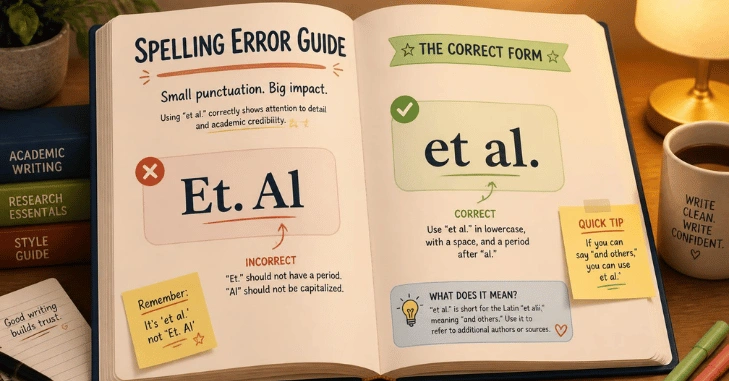
These three errors account for nearly every appearance of the phrase that a copy editor has to fix.
- “Et al.” puts the period on the word that needs none and withholds it from the word that needs one. It is the rule exactly reversed.
- “Et. al.” doubles the mistake. Two periods, one of them indefensible.
- “Et al.” is phonetic. Somebody heard the phrase, wrote what their ear reported, and produced two English words that mean nothing together. “All” is not Latin and never was.
One more variation is defensible, though not in American writing. Some journals and British house styles drop the period entirely and print the phrase bare. If you are writing for a US audience, keep the period. Every major American style guide expects it.
Hyphenating the phrase is not a house style anywhere. There is no reason to join the two halves, because they are two separate words doing two separate jobs.
How Courts Handle Multiple Parties
A caption is the block of text at the top of a filing that names who is suing whom. When several people sit on one side, the caption names the first and sweeps up the rest. A claim against a company and its three officers might be captioned Whitaker v. Delcourt Holdings, LLC, et al. That tells you the docket holds more defendants than the caption prints.
Property records behave the same way. A deed or a county assessor’s record that names one owner and then the Latin tag usually means co-owners; the clerk did not print it. Often those are siblings who inherited a parcel together. Older deeds carry a cousin of the phrase “et ux,” short for “et uxor,” meaning “and wife.”
Now the part most explainers skip. The caption keeps the tag, and a Bluebook citation throws it out. Rule 10.2.1 tells you to name only the first party on each side and to cut the words that signal extra parties. A brief citing the same case therefore writes “Whitaker v. Delcourt Holdings,” with no hint that anyone else was ever involved.
That is not sloppiness. Captions identify a file in a clerk’s office. Citations identify a published opinion in a reporter. Different jobs, different rules.
Author Counts in APA, MLA, and Chicago
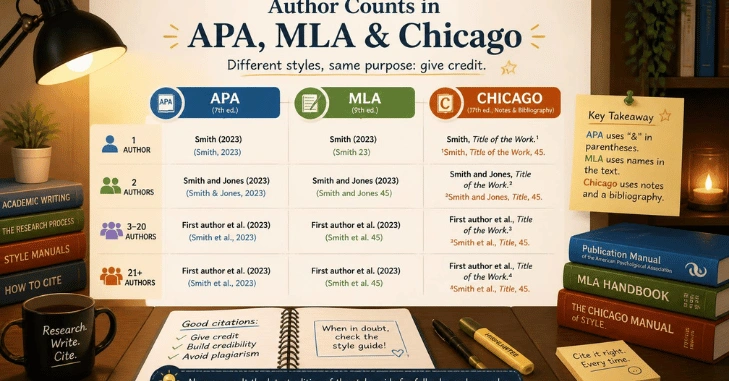
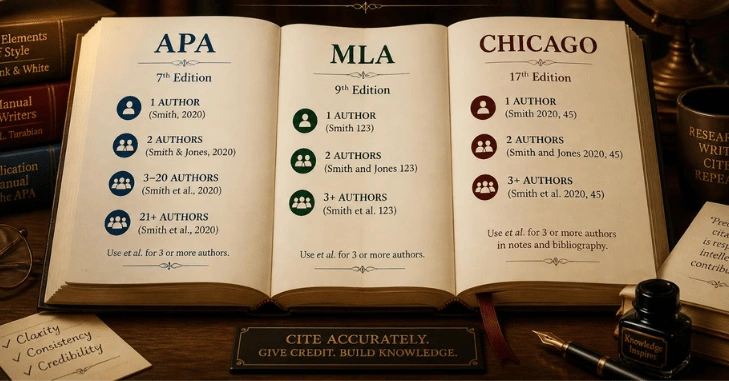
Academic style uses the same abbreviation for a different purpose: to keep in-text citations out of the reader’s way. The pattern never changes: first the author’s surname, then the tag, then whatever the style asks for next. What changes is the number of authors that triggers it.
- APA, 7th edition. Three or more authors, shortened from the very first citation. The reference list never shortens and prints up to 20 names in full; past 20, it gives the first 19, an ellipsis, then the final author.
- MLA, 9th edition. Three or more authors, shortened in both the Works Cited entry and the in-text citation. In a narrative sentence, MLA prefers that you write “and colleagues.”
- Chicago. Notes shorten at four or more authors. A bibliography prints up to ten names, and only past ten does it give the first seven followed by the tag.
- Medical journals. Vancouver-style reference lists commonly print six names before shortening, so read the journal’s own instructions instead of guessing.
Two authors never get shortened under any of these styles. Name both every time. If you are building these habits from scratch, a reading list of law books that sharpen legal writing will drill the citation forms harder than any single explainer can.
Grammar Details Writers Get Wrong
Commas. A single name before the tag takes no comma. Two or more names take a serial comma first, exactly the comma you would put before “and.”
Verb agreement. Because the subject is a group of people, the verb is plural. Write “report,” not “reports.” A singular verb is the tell that somebody read the phrase as one thing rather than several.
Italics. APA, MLA, and Chicago all treat the phrase as ordinary English now, so it is not italicized. Older house styles italicized every Latin borrowing. Most gave that up decades ago.
Possessives. An apostrophe and an ‘s’ go after the period, never inside it.
Sentence endings. One period does both jobs. Do not type a second one.
How to pronounce it. Two syllables, with the stress on the second, and that second syllable rhymes with “pal.” Mispronouncing it as “et al. l” is how the misspelling keeps spreading.
Versus “etc.” “Etc.” is short for “et cetera,” and “and the rest” stands in for things. Our Latin tag stands in for people. Confuse the two, and you have either turned co-defendants into objects or a pile of objects into a crowd.
Your Next Step
Et Al. Match the rule to the document sitting in front of you and filing something? Copy the caption exactly as the docket shows it, then strip the tag when you cite the opinion later—writing a paper instead? Count the authors, then apply your style’s threshold and stop worrying about it.
Those two systems look identical and behave differently, and mixing them up is the slip a careful reader spots first. The same trap catches “per se,” which people write as per se without recognizing the error, and the fix in both cases is knowing the original Latin.
Frequently Asked Questions
Only the first is correct. “Et” is a whole word and needs no period, while “al” is cut short and needs one. Remember which half is truncated and you will never misplace the dot again.
No. “Et al.” is not Latin, not English, and not a recognized alternative. Every style guide that bothers to mention it lists it as an error.
Three in APA and MLA. Four in a Chicago note. Two authors are always named in full, whatever the style.
It signals to owners that the record did not print, usually for people who took title together or heirs sharing a parcel. Pull the full deed or the recorder’s index before you rely on any single name.
No. Bluebook rule 10.2.1 removes it, along with every party after the first on each side. Keep it in the caption of the document you are filing, which has to match the court’s own file.
No. With two names, you write both. The abbreviation only earns its place once a third person appears.